First-time visitors
Anchor each day around one major attraction or area in Normandy, leave evenings flexible, and skip the second museum. Use one orientation tour early to get your bearings.
See suggested experiences
Preview travel guide
A practical overview of Normandy: where to start, how the destination is laid out, when to visit, and how to plan a first trip.
Normandy is a region in northern France that was restructured administratively in 2016 by merging Basse-Normandie and Haute-Normandie. It is characterized by a mix of rural landscapes with flat grasslands, gentle hills, and agricultural activity, alongside significant urban centres clustered mainly along the lower Seine valley.
Normandy is divided into five départements: Manche, Calvados, Orne, Eure, and Seine-Maritime. Population and economic activity are focused primarily in the lower Seine valley, where the cities of Rouen and Caen act as principal administrative and commercial hubs. The northern coast includes the important port city of Cherbourg in Manche and the industrial city of Le Havre at the Seine’s mouth. The region balances urban centres with extensive rural areas, including the Pays d’Auge known for dairying and horse-rearing, and the Vexin area with extensive cereal farming on flatlands.
Rouen, the historical capital in the lower Seine valley, offers a blend of medieval architecture and commercial vitality. Caen, larger and located more centrally, serves as both an administrative centre and a cultural hub. Along the coast, Cherbourg stands out as a major port, while Le Havre is known for its oil refining and petrochemical industries. In the countryside, the Pays d’Auge region features rolling hills and farmland, and the Alabaster Coast along Seine-Maritime is marked by dramatic chalk cliffs that define the local landscape.
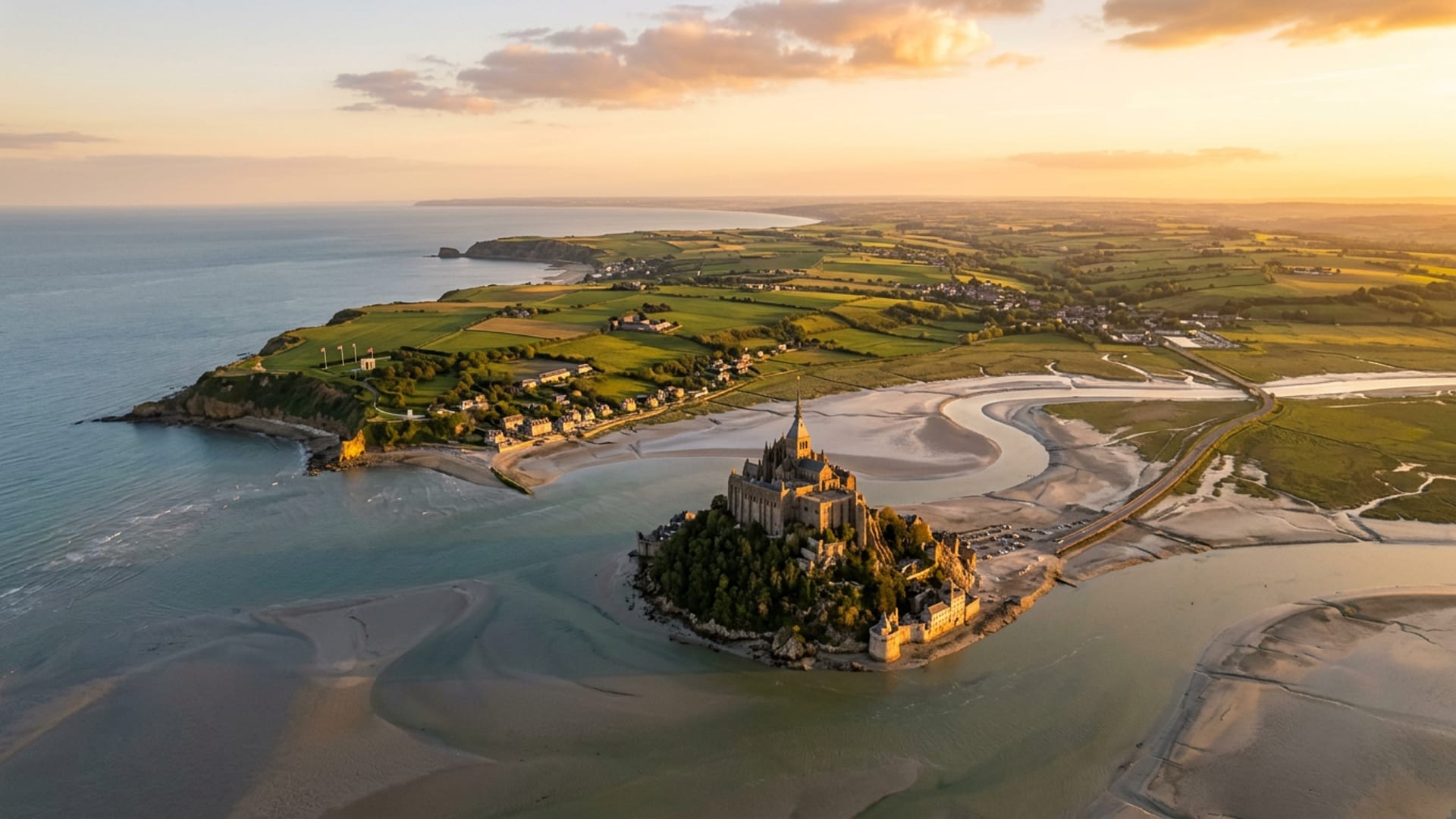
Normandy’s geography includes flat grasslands interrupted by gentle hills and hedgerows, with a coastline notable for its white chalk cliffs, especially along the Alabaster Coast. The region’s climate is temperate oceanic, with mild summers and cool, wet winters. Mont-Saint-Michel, an island commune off the Manche coast, is accessible only at low tide, emphasizing the rapid tidal changes characteristic of this coastline. Agricultural activities are diversified, ranging from dairying in the central hills to cereal farming in the eastern plains.
Normandy works best as a two- or three-town trip, threading by short drives or local transport between bases. Pick the bases by character — historic centre, coastal town, mountain village — and let the geography set the pace.
Starting points for shaping the trip around the style that fits — not a fixed itinerary.
Anchor each day around one major attraction or area in Normandy, leave evenings flexible, and skip the second museum. Use one orientation tour early to get your bearings.
See suggested experiencesA 2–3 day visit in Normandy works best when you commit to one base and one or two anchors per day, rather than moving between towns or trying to "see everything".
See suggested experiencesSeven days or more lets you pair a city stay with a regional or coastal add-on. Pick a contrast — urban + nature, or central + countryside — and use the longer window for slower mornings.
See suggested experiencesChoose attractions with clear timings and skip-the-line tickets, keep at least one outdoor or interactive stop in each day, and protect downtime — pacing matters more with kids.
See suggested experiencesBuild the trip around the landscape: trails, viewpoints, day-from-base outings, and any signature activity. Book weather-sensitive plans early and keep a buffer day if you can.
See suggested experiencesPick one or two stretches of coast rather than chasing the perfect beach. Local boats and ferries set the pace; flexible dates beat fixed itineraries when weather is in play.
See suggested experiencesFour distinct seasons each shape a different trip. Pick the season for what you want to do, not the other way around.
Mild, lighter crowds, gardens at their best. Good time to visit Normandy if you want walking weather without summer prices.
Peak season — best weather but the busiest, most-expensive window. Book major sites and trains weeks ahead.
Often the quiet sweet spot: autumn colour, harvest food, lower hotel rates. Pack layers — late autumn turns cool fast.
Quietest, cheapest, sometimes coldest. Good for museum-led city visits, Christmas markets, or skiing where applicable.
Weather varies by region and altitude — check forecasts close to travel rather than assuming the season.
Direct answers to the questions most travellers actually ask before they book.
Named districts, beaches, viewpoints and points of interest. Hover a pin to see its description.
Other travel resources that complement this preview guide.
Visit Normandy is one of 179 destination micro-sites across the Visit Network — independent guides, written by editors who actually go.
You may also be interested in: VisitAnnecy.com, VisitCarcassonne.com, VisitFrance.com, VisitParis.com
Are you a hotel, tour operator, local guide, contributor, or potential partner? We're expanding the Normandy guide and would like to hear from you. Send us a note and we'll reply personally.